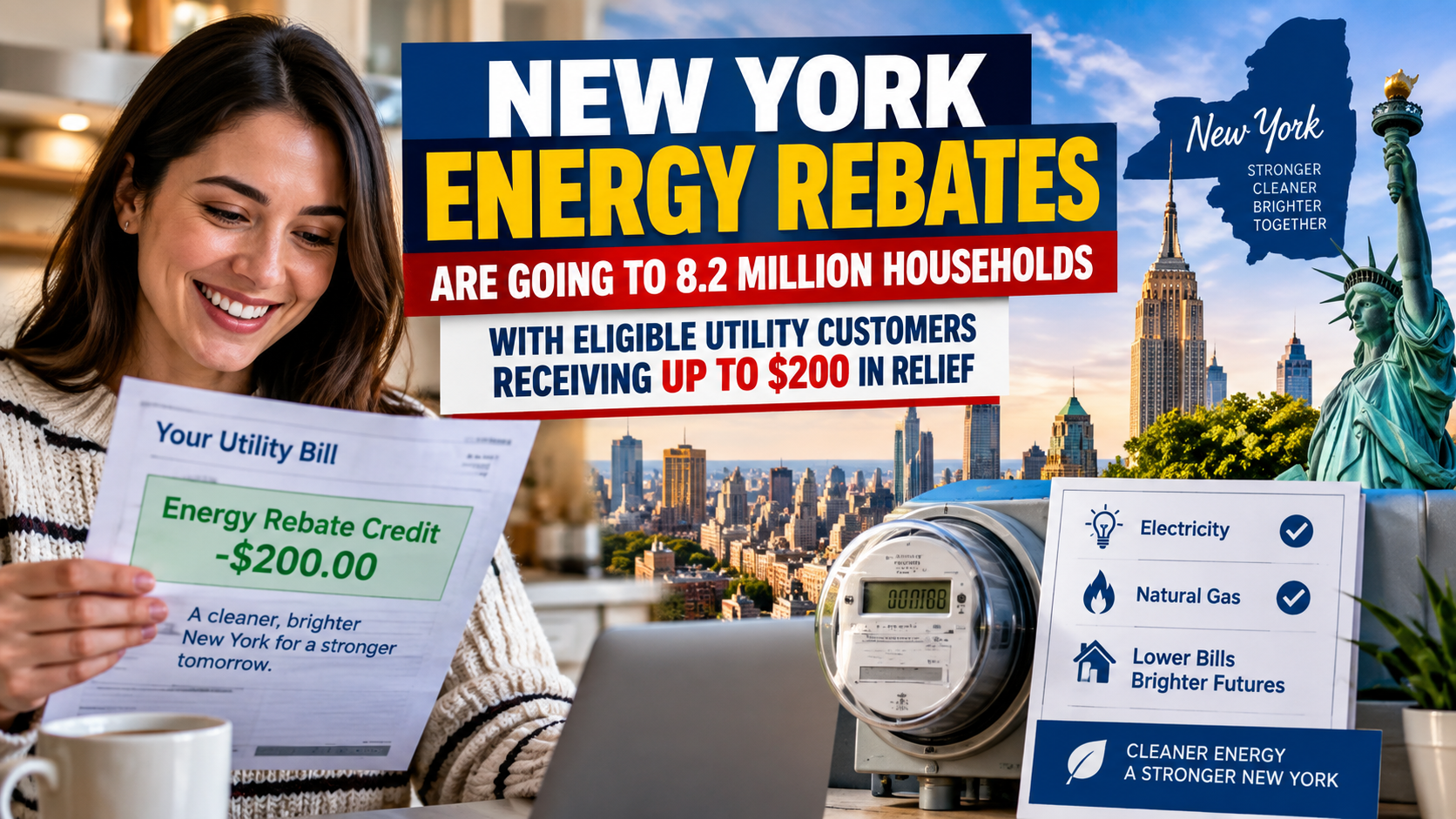
New York households are getting some relief on their energy bills, and unlike many viral “rebate check” stories floating around online, this program came directly from the state government. More than 8.2 million New York households are receiving energy-bill credits under a state initiative announced by Governor Kathy Hochul, with residential customers generally seeing credits of up to $200, depending on their utility and service.
The relief doesn’t work quite like a stimulus check arriving in the mailbox. For most customers, the money appears as an automatic credit on their utility bill, meaning eligible households generally don’t have to fill out an application or chase down a special government form. With electricity and natural-gas costs squeezing household budgets, that’s an important distinction—and one worth understanding before the inevitable “New York is sending $200 checks” posts start making the rounds.
New York Energy Rebates: What Was Announced?
New York established the relief as part of an effort to reduce the impact of rising energy costs on residential customers.
According to the official announcement from Governor Kathy Hochul’s office, more than 8.2 million households across the state are expected to benefit.
The program provides credits to residential electricity and natural-gas customers through participating utilities.
Here’s the basic picture:
| Program detail | What New Yorkers should know |
|---|---|
| Households affected | More than 8.2 million |
| Maximum residential relief | Up to $200, depending on utility/service |
| Application required | Generally no |
| How relief arrives | Credit applied to eligible utility bills |
| Income application | Not generally required for the broad credit |
| Purpose | Offset elevated household energy costs |
| Is it a federal IRS payment? | No |
The precise amount isn’t identical for every household. It depends on the customer’s utility and whether the household receives electricity, natural gas or both.
How Much Money Could Households Actually Receive?
This is where the headline needs a little unpacking.
“Up to $200” doesn’t mean every New Yorker wakes up to an extra $200 sitting in a bank account.
The state’s relief is structured around utility-bill credits, and the amount varies by service territory and type of energy service. A household receiving both electricity and natural gas may see a different total than an electricity-only customer.
The state estimated residential customers could receive up to approximately $200 in total relief.
For a family staring at a summer cooling bill or preparing for another expensive heating season, $200 isn’t life-changing money. Still, it’s enough to cover groceries, a tank or two of gas, or simply keep the utility account from drifting further behind.
And, crucially, households generally don’t have to apply.
Do New Yorkers Need to Apply for the Energy Credit?
For the broad residential utility relief, eligible customers generally do not need to submit an application.
That’s arguably one of the most consumer-friendly parts of the program.
Instead of asking millions of people to navigate another portal, upload documents and wait for approval, the relief is administered through utilities and reflected directly on qualifying customer accounts.
New Yorkers should inspect their utility statements rather than expecting a Treasury-style paper check.
Consumers can also review energy-related information through the New York State Department of Public Service and should contact their utility if they believe an expected credit hasn’t appeared.
Be wary of anybody offering to “register” you for the rebate in exchange for a fee, Social Security number or banking credentials.
You shouldn’t have to pay someone to unlock an automatic utility credit.
Which New York Households Are Included?
The relief reaches customers across New York’s major investor-owned utilities.
That means millions of households served by companies including Consolidated Edison, National Grid, NYSEG, RG&E, Central Hudson and Orange & Rockland are among those affected by the state’s energy-relief measures.
Actual credits vary because utility rates and energy services aren’t uniform statewide.
A Manhattan apartment using electricity but receiving heat through a building-wide system doesn’t have the same energy profile as a Buffalo household paying separate electricity and natural-gas bills.
That’s why one statewide dollar figure can’t accurately describe what every individual customer receives.
Why Is New York Providing Energy Relief?
Energy affordability has become a significant household-budget issue.
Electricity and natural-gas bills aren’t discretionary expenses. You can postpone buying a new television; you can’t exactly tell the refrigerator to take the month off.
New York officials have pointed to rising utility costs and broader affordability pressures when describing the relief effort.
The state regulates investor-owned electric and gas utilities through the Public Service Commission. Consumers interested in how New York reviews utility rates can find regulatory proceedings and consumer resources through the Department of Public Service.
The rebate initiative effectively uses state-backed relief to reduce bills rather than permanently rewriting the underlying utility-rate structure.
That’s an important difference.
A one-time $200 credit can soften a painful bill. It doesn’t guarantee that future electricity or gas prices will decline.
Is This the Same as HEAP?
No.
New York’s Home Energy Assistance Program, commonly known as HEAP, is a separate assistance program designed to help eligible households with heating and energy costs.
HEAP generally has eligibility requirements tied to factors such as household income, household composition and heating circumstances. Residents can find official information through New York’s Home Energy Assistance Program page.
The broad energy credit described in the governor’s announcement operates differently.
That distinction matters for lower-income households because receiving an automatic utility credit doesn’t necessarily mean you’ve exhausted other energy-assistance options.
A qualifying household may still want to investigate HEAP and other affordability programs separately.
How Will the Credit Appear on a Utility Bill?
Customers should look for a clearly identified credit or adjustment on their bill.
Don’t panic if you don’t see a physical “rebate check” in the mailbox.
Despite language sometimes used to describe these payments, the practical mechanism is generally a reduction to the amount owed on the utility account.
Suppose your bill would otherwise have been $240 and an applicable $100 credit is posted. The credit effectively lowers what you owe to $140, assuming there aren’t other balances or adjustments.
That’s real financial relief, even though no $100 deposit ever touches your checking account.
What Should You Do If the Credit Doesn’t Show Up?
First, verify whether your utility and service qualify and whether credits have already been distributed for your customer category.
Then check the entire statement rather than only the “amount due” box. Utility bills can contain multiple adjustments, taxes and charges, making a one-time credit surprisingly easy to miss.
If you believe you’re eligible but can’t find the credit, contact your utility using the phone number or website printed on your normal statement.
Avoid customer-service numbers supplied through unsolicited text messages or social-media advertisements.
For unresolved utility issues, New York consumers can also review complaint and consumer-assistance options through the state’s Department of Public Service.
Watch Out for Fake $200 Rebate Messages
Automatic government benefits have an unfortunate side effect: scammers love them.
A message might say, “Your $200 New York energy rebate is waiting—click here to claim.”
That’s exactly the kind of language that should make you suspicious.
If the credit is being automatically applied through your utility, there should be no reason for a stranger to demand your debit-card number, online banking password or payment to “release” it.
Go directly to your utility’s official website or New York government resources.
The extra thirty seconds spent checking the address can save months of dealing with identity theft.
Fact Check: Is New York Sending $200 Energy Rebate Checks?
The energy relief is real, but “$200 checks” can be an oversimplification.
New York officially announced energy-bill relief reaching more than 8.2 million households, with residential customers potentially receiving up to $200, depending on their utility and energy services.
But eligible residents shouldn’t necessarily expect a physical $200 check or bank deposit.
The relief is generally delivered through automatic utility-bill credits, and individual amounts vary.
There’s also no universal promise that every New York resident receives exactly $200.
So, yes—the state-backed energy relief is genuine. Just check your utility bill before checking your mailbox.
FAQs:
Is New York really giving households a $200 energy rebate?
New York has authorized energy-bill relief for more than 8.2 million households. Residential customers can receive up to roughly $200 depending on their utility and services.
Do I need to apply for the New York energy rebate?
The broad residential utility credits are generally applied automatically to eligible customer accounts rather than requiring a separate application.
Will I receive a $200 check in the mail?

Generally, the relief is delivered as a credit on an eligible utility account, not as a $200 paper check or direct bank deposit.